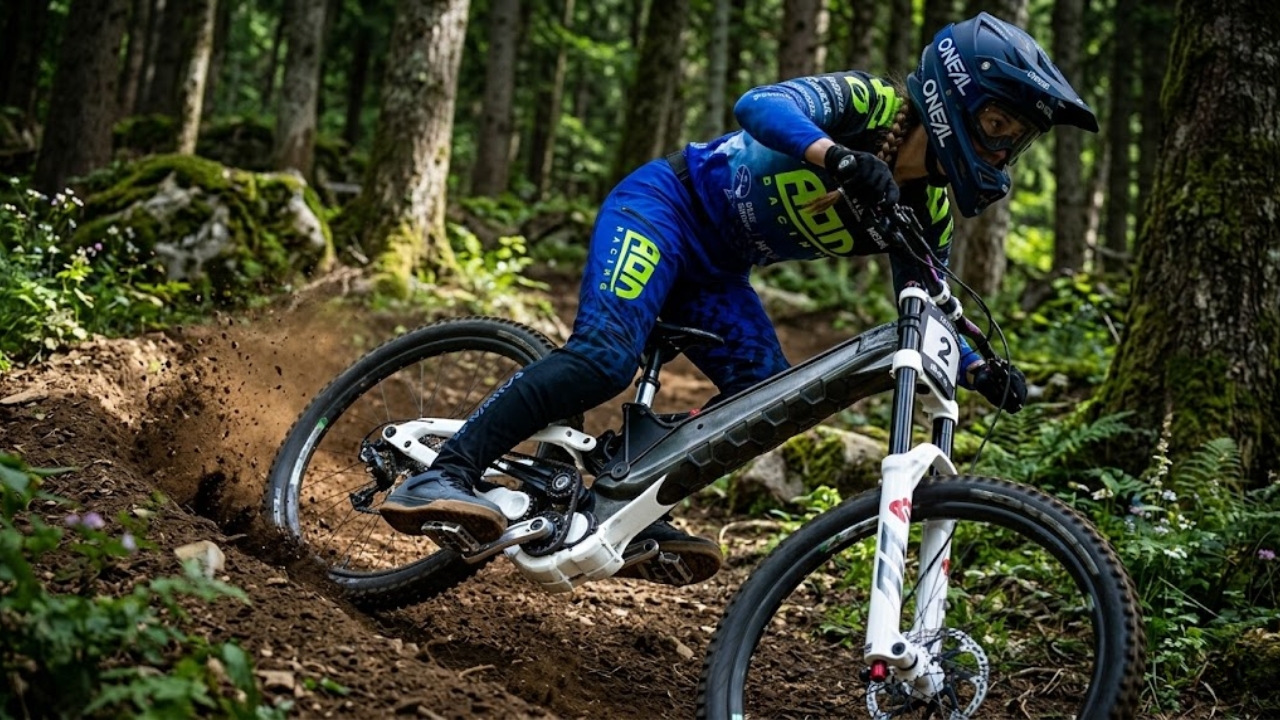
The downhill mountain bike world has always thrived on innovation hidden behind race pits, prototype decals, and carefully disguised engineering experiments. Every World Cup season introduces subtle changes that eventually shape the next generation of production bikes, but occasionally a prototype appears that immediately captures industry attention. That is exactly what happened when the AON Racing x Gamux Gearbox downhill bike surfaced during testing sessions, revealing a fascinating glimpse into the future of gravity racing technology.
At first glance, the bike already looked radically different from the standard carbon race machines dominating modern downhill tracks. The frame geometry, oversized center section, and unconventional suspension layout suggested that this was not simply another boutique downhill frame with cosmetic updates. Instead, it appeared to be a genuine attempt to rethink how a race bike should function under the extreme demands of World Cup competition.
The partnership between AON Racing and Gamux signals a growing movement in downhill racing toward drivetrain integration, weight centralization, and improved suspension behavior. With gearbox systems slowly gaining credibility among elite racers, this prototype may represent one of the most serious attempts yet to challenge the dominance of traditional derailleur-based setups.
Why Gearbox Bikes Are Returning to the Spotlight
For years, gearbox bikes occupied a strange position within mountain biking. Riders admired the concept but questioned the practicality. Traditional derailleur systems remained lighter, easier to maintain, and more familiar to mechanics and racers alike. However, downhill racing has evolved dramatically over the past decade, and the advantages of gearbox systems are beginning to outweigh their compromises.
One of the biggest benefits is unsprung weight reduction. By moving drivetrain mass away from the rear wheel and concentrating it near the bike’s center, suspension performance can improve significantly. A lighter rear wheel reacts faster to terrain changes, allowing the suspension to track rough sections with greater sensitivity and control.
The AON Racing x Gamux prototype appears to embrace this philosophy completely. Instead of hanging a derailleur from the rear axle area, the bike centralizes much of the drivetrain hardware within the frame. This creates cleaner chain management while reducing the risk of catastrophic derailleur damage during races.
Modern downhill tracks have become brutally technical. Riders now encounter larger compressions, rougher rock gardens, and higher average speeds than ever before. In such conditions, drivetrain reliability becomes a crucial performance factor. A gearbox system protected inside the frame offers clear advantages in durability and consistency, especially during wet and muddy race weekends.
Another major advantage is chain stability. Traditional drivetrains often experience chain growth and pedal kickback under heavy suspension movement. Gearbox platforms can minimize these effects through optimized suspension kinematics, resulting in smoother rear wheel behavior through rough terrain.
The Prototype Frame Design Signals a New Direction
The frame itself is perhaps the most intriguing aspect of the entire build. Rather than relying on conventional downhill frame aesthetics, the Gamux prototype features a highly purposeful silhouette focused on performance over appearance.
The oversized central frame section likely houses the gearbox assembly while simultaneously increasing chassis stiffness. This creates a more rigid structure around the bike’s center of gravity, potentially improving cornering precision and high-speed stability. Downhill racers constantly seek bikes that remain composed under violent impacts, and the prototype seems engineered specifically for that challenge.
The suspension layout also stands out immediately. The bike appears to use a high-pivot configuration paired with an idler pulley system. High-pivot bikes have surged in popularity at the World Cup level because they allow the rear axle path to move backward during impacts. This helps the rear wheel absorb square-edge hits more effectively while maintaining momentum through rough terrain.
Combining a high-pivot system with a gearbox creates a particularly interesting engineering opportunity. Because the drivetrain is no longer dependent on a rear derailleur setup, designers gain greater freedom to optimize suspension behavior without compromising shifting performance.
The long wheelbase and aggressive geometry suggest the bike is designed specifically for modern race tracks where stability at speed matters more than nimble low-speed handling. Steeper tracks and faster sections increasingly reward bikes that remain planted under pressure, and this prototype appears built with that exact purpose in mind.
Hidden World Cup Innovations Beneath the Surface
While the visible frame design attracts immediate attention, many of the most important innovations are likely hidden beneath the surface. Prototype downhill bikes often serve as rolling laboratories for technologies that may eventually influence the broader cycling industry.
One area likely receiving significant development attention is anti-squat behavior. Gearbox bikes allow engineers to manipulate chain forces differently than traditional drivetrain systems. This can help reduce unwanted suspension movement during pedaling while maintaining traction across technical terrain.
Another probable focus is vibration damping. Modern downhill racing places enormous physical strain on riders. Fatigue reduction has become an increasingly important performance factor, especially during multi-day World Cup events. The frame construction and suspension tuning on the Gamux prototype may include advanced damping strategies designed to reduce rider fatigue over long descents.
Wheel stiffness balance could also play a role. With reduced unsprung weight at the rear, engineers may tune wheel characteristics differently than on conventional bikes. This can potentially improve tracking and cornering grip under aggressive loads.
The bike’s integration level further suggests a focus on race efficiency. Cable routing appears exceptionally clean, reducing contamination risk while simplifying maintenance between runs. Professional race teams prioritize reliability above almost everything else, and integrated systems can provide valuable consistency during demanding race weekends.
Cooling management may even be part of the design philosophy. Gearbox systems generate heat differently than standard drivetrains, especially during extended descending. Frame airflow and gearbox housing design likely play important roles in maintaining consistent mechanical performance.
How the Prototype Could Influence Future Downhill Bikes
Even if this exact prototype never reaches mass production, its influence on future downhill bike development could be substantial. World Cup racing has historically acted as a testing ground for ideas that later become industry standards.
High-pivot suspension designs were once considered niche concepts. Today, they dominate elite downhill racing. Similarly, integrated frame storage once seemed unnecessary before becoming common on trail and enduro bikes. Gearbox systems may now be approaching a similar turning point.
If the AON Racing x Gamux platform proves competitive at the highest level, other manufacturers will almost certainly increase gearbox development investment. Major brands closely monitor World Cup trends because racing success strongly influences consumer interest.
The prototype may also accelerate experimentation with frame architecture. Traditional bicycle layouts have remained relatively consistent for decades, but gearbox integration enables designers to rethink weight distribution and structural design in entirely new ways.
Suspension engineers will likely pay close attention as well. The interaction between drivetrain forces and rear suspension behavior represents one of the most complex aspects of downhill bike design. Gearbox platforms offer opportunities to simplify and optimize that relationship.
Consumer perceptions could shift rapidly if professional racers begin consistently achieving strong results on gearbox-equipped bikes. Mountain biking culture often evolves through race-driven credibility, and elite athlete endorsement carries enormous influence.
The Challenges Still Facing Gearbox Downhill Bikes
Despite the excitement surrounding the prototype, gearbox downhill bikes still face several significant challenges before widespread adoption becomes realistic.
Weight remains one of the biggest concerns. Although modern gearbox systems have improved considerably, they are often still heavier than conventional drivetrains. Downhill racing places less emphasis on climbing efficiency, but total bike weight still affects handling characteristics and rider confidence.
Maintenance complexity can also discourage adoption. Many riders and mechanics are deeply familiar with derailleur systems, while gearbox technology requires specialized knowledge and servicing procedures. Teams must invest time and resources into understanding entirely different drivetrain behavior.
Cost presents another obstacle. Advanced gearbox systems and custom prototype frames are expensive to develop and manufacture. Bringing such technology to the consumer market at competitive pricing remains difficult.
There is also the challenge of rider adaptation. Professional racers spend years developing muscle memory around traditional drivetrain feel and suspension feedback. Switching to a radically different platform can require substantial adjustment, even if the technology ultimately offers advantages.
Still, innovation in downhill racing has never been driven by comfort or familiarity. The sport rewards experimentation, especially when the potential performance gains are significant.
A Glimpse Into the Future of Gravity Racing
The AON Racing x Gamux Gearbox DH bike represents more than just another intriguing prototype hidden in the World Cup pits. It reflects a broader shift in downhill mountain biking toward integrated engineering solutions focused on suspension efficiency, durability, and high-speed control.
Whether this exact bike becomes a race-winning platform or simply influences future designs, its appearance confirms that downhill development is entering another period of rapid experimentation. Riders, engineers, and teams are increasingly willing to challenge long-standing assumptions about what a race bike should look like and how it should perform.
As downhill tracks continue becoming faster and more demanding, the pressure to innovate will only increase. Traditional drivetrain systems still dominate the sport today, but prototypes like this demonstrate that alternative technologies are no longer fringe concepts. They are serious contenders in the search for competitive advantage.
For fans of gravity racing, that makes the current era especially exciting. Hidden beneath the raw speed and spectacle of World Cup competition is an ongoing engineering battle shaping the future of mountain biking itself.
